Zinc Fluoride: A Versatile Inorganic Fluoride
Introduction
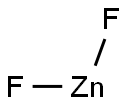
Zinc fluoride (ZnF2) has the CAS number 7783-49-5, chemical formula ZnF2, and molar mass 103.37 g/mol; its tetrahydrate (ZnF2·4H2O) has the CAS number 13986-18-0 and molar mass 175.45. Anhydrous form: It is a white crystalline powder or a solid mass with a relative density of 4.95, a melting point of 872 °C and a boiling point of about 1500 °C. ZnF2 is in the rutile structure (P42/mnm) at room temperature [1]. It is slightly soluble in water, but soluble in hot water, hot acids and aqueous ammonia. It is insoluble in ethanol. At 100 °C, the hydrate loses its water of crystallisation, and by heating in a vacuum, it can be dehydrated to obtain the anhydrous substance. Zinc fluoride can be a Lewis acid catalyst for some organic reactions [2]. In situ FTIR with probe molecules has characterised the surface Lewis acidity of ZnF2 [3]; it is weaker than that of MgF2, and there are also some base sites, so it can be used as a heterogeneous catalyst. Ceramic glazes, fluorescent lamp phosphors, wood preservation and other places have all been using it.

Figure 1. Physicochemical properties of zinc fluoride
Pharmacokinetics and biological effects
Zinc fluoride is an industrial chemical that can harm people; too much fluoride during the development of teeth causes dental fluorosis. Zinc fluoride dissociates in the acidic environment of the stomach after ingestion. Most of the fluoride is rapidly and almost completely absorbed into the blood from the gastrointestinal tract. A comparative risk study of inorganic binary fluorides has shown that zinc fluoride tetrahydrate can carry fluoride into the bloodstream, and it is excreted from the body via urine more easily than with most other compounds tested [4]. After entering the blood, fluoride ions are distributed throughout the body and accumulate in calcified tissues of the bones and teeth. Fluoride substitutes the hydroxyl group in hydroxyapatite to form fluorapatite; it is relatively insoluble in acid.
Zinc fluoride is not metabolized. Most absorbed fluoride is excreted by the kidneys. Zinc is a necessary micronutrient, and although it is required in the body, too much zinc will be excreted via faeces. A study on the effect of dietary zinc and iron on fluoride utilisation in rats has provided some information on zinc-fluoride interactions [5]; a small amount of released fluoride can help inhibit tooth decay. However, the biological effect of zinc ions released together with fluoride ions is not the same as that of simple alkali metal fluorides; the counter ion and its solubility affect the biological impact of fluoride.
Toxicity
Zinc fluoride is poisonous if swallowed and can irritate the respiratory tract and skin. A risk assessment study on fluoride compounds has found that sodium fluoride, potassium fluoride and zinc fluoride tetrahydrate are among the most harmful to the kidneys and liver, and may cause stomach upset, nausea and vomiting upon ingestion. Release of hydrofluoric acid in the stomach can cause systemic fluoride poisoning and hypocalcaemia (low blood calcium) and cardiac arrhythmia; dust and fumes can also irritate the mucous membranes of the upper respiratory tract. Chronic exposure to high fluoride causes skeletal fluorosis [6].
It can be harmful to the skin and eyes. Contact with moisture on the skin can result in the formation of corrosive hydrofluoric acid and cause burns. Ensure good ventilation in the work area or use a fume hood. Gloves and goggles must be worn at all times. If it is swallowed, medical personnel can give calcium gluconate to bind with the free fluoride ions; otherwise, get medical help promptly.
Preparation method
Depending on whether the anhydrous or hydrated product is required, several ways can be used to produce zinc fluoride. Fluorolytic sol-gel synthesis of ZnF2 has been used to prepare xerogels with a very large surface area; therefore, various analyses have been conducted, such as elemental analysis, thermal analysis, powder XRD, solid-state MAS NMR and N2 adsorption-desorption measurements. Generally, the industrial route is to react zinc oxide (ZnO) or zinc carbonate (ZnCO3) with hydrofluoric acid (HF). It is exothermic and produces zinc fluoride and water (or carbon dioxide).
ZnO + 2HF → ZnF2 + H2O
Add a soluble zinc salt, such as zinc sulfate, to an aqueous solution of a soluble fluoride salt, for example, sodium fluoride or ammonium fluoride. Zinc fluoride precipitates; then filter and dry the precipitate. To obtain the anhydrous form from the tetrahydrate, heat the crystals in a stream of dry hydrogen fluoride gas or in a vacuum oven to prevent hydrolysis and the formation of zinc oxyfluoride.
References
[1] Wu, X., & Wu, Z. (2006). Theoretical calculations of the high-pressure phases of ZnF2 and CdF2. European Physical Journal B, 50(4), 521–526.
[2] Guo, Y., Wuttke, S., Vimont, A., Daturi, M., Lavalley, J.-C., Teinz, K., & Kemnitz, E. (2012). Novel sol–gel prepared zinc fluoride: synthesis, characterisation and acid–base sites analysis. Journal of Materials Chemistry, 22(29), 14587–14593.
[3] Hamada, T., Manabe, K., & Kobayashi, S. (2006). Catalytic asymmetric Mannich-type reactions activated by ZnF2 chiral diamine in aqueous media. Chemistry–A European Journal, 12(4), 1205–1215.
[4] Usuda, K., Kono, R., Ueno, T., Ito, Y., Dote, T., Yokoyama, H., Kono, K., & Tamaki, J. (2015). Comparison of the Biological Impacts of the Fluoride Compounds by Graphical Risk Visualization Map Technique. Biological Trace Element Research, 167(1), 84–90.
[5]Cerklewski, F. L., & Ridlington, J. W. (1985). Influence of Zinc and Iron on Dietary Fluoride Utilization in the Rat. The Journal of Nutrition, 115(9), 1162–1167.
[6] Thakur, R., & Patial, B. (2026). Neglected parathyroids: Fluoride’s trigger for skeletal fluorosis and endocrine domino effect. Journal of Trace Elements in Medicine and Biology, 96, 127916.
You may like
See also


Lastest Price from Zinc fluoride manufacturers
2024-11-19
- CAS:
- 7783-49-5
- Min. Order:
- 1BAG
- Purity:
- ≥99.9%
- Supply Ability:
- 10 Tons